PERINATAL LOSS RESOURCES
Perinatal loss can happen to anyone and you are not alone. All losses are profound and all parents need support during this time. It is common to have a wide range of emotions. This page is here to provide information, resources, and support. If you need help navigating all of this and finding your next steps please call or text our Warm Line at 1-888-404-7763. There are many resources available to you and we will help you find the support you need.
The Warm Line offers peer & professional support. Call or text today.
1-888-404-7763
** se habla español
You are not alone. Relief can begin with a simple phone call.
Loss Peers

Emily McKinley, Peer Support Specialist Supporting Perinatal Loss Families
Emily McKinley, MSW, LICSWA (she/they), Peer Support Specialist Supporting Perinatal Loss Families
Emily comes to this work with deep compassion, humility, and a belief that grief is not something to be fixed or overcome, but a natural expression of love that deserves witness, care, and community.
Emily first joined PS-WA as a Master of Social Work intern and later served as a Warm Line Specialist, supporting families experiencing perinatal mood and anxiety disorders, reproductive loss, grief, and the many emotional transitions of pregnancy and early parenthood.
Emily is an artist, community organizer, Licensed Independent Clinical Social Worker Associate (LICSWA), and death, grief, and loss doula. She has spent several years accompanying individuals and families through serious illness, dying, bereavement, and other profound life transitions. She has facilitated grief support groups and community conversations that foster connection, reduce isolation, and create spaces where people can bring the fullness of their grief.
Drawing from both professional training and personal experiences with fertility challenges and perinatal loss, Emily brings a relationship-centered approach to her work that is informed by somatic and nature-based perspectives. She recognizes that grief is experienced not only in our hearts and minds, but also in our bodies, our relationships, and our connection with the natural world. She believes grief and love are inseparable-that we grieve because we love. No one should have to carry grief alone, and she is honored to accompany parents as they navigate loss while continuing to honor the love they carry.
emily (dot) mckinley (at) perinatalsupport.org

Amy Menjivar, Peer Support Specialist Supporting Loss and Latinx families

Amy Menjivar (she/her), Peer Support Specialist
Amy is a Latina and mother of two children and PMAD’s survivor and Bilingual Spanish speaker. She has a passion to provide strong contributions to our society, with awareness of the use of stigmatizing language around mental illness. She has a background in Early Childhood Education and has worked with children for the past 9 years. She has supported King County Families and children of all ethnicities with special needs. She has worked mostly with Latin families as their family support specialist.
Amy is passionate about helping the community, engaging families and building community. She is committed to help immigrants in the community and teach families that there is someone here to listen to them and also to receive help.

Partners

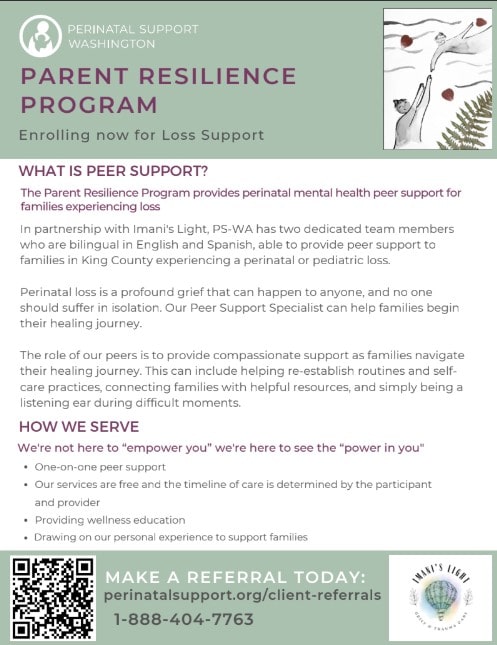
The role of our peers is to provide compassionate support as families navigate their healing journey. This can include helping re-establish routines and self-
care practices, connecting families with helpful resources, and simply being a listening ear during difficult moments.
We're not here to “empower you” we're here to see the “power in you"
We offer:
- One-on-one peer support
- Our services are free and the timeline of care is determined by the participant
and provider - Providing wellness education
- Drawing on our personal experience to support families
Ongoing Loss Support Groups:
SEATTLE Parent Support Group, In person at Seattle Children’s Hospital in the Anna Clise Board Room – RB 3.614. 7:30 p.m. Third Wednesday. Contact Casey at Casey.Raker@gmail.com.
VIRTUAL Parent Support Group, Virtual via Zoom click HERE to join. 7:30 p.m. Second Monday. Contact: Liz at lizzylove1@aol.com.
As part of our new acquisition of the nonprofit Parent Support of Puget Sound, which focuses exclusively on miscarriage, stillbirth, and infant loss, we are presenting their peer support groups and resources. Please read the welcome packet information linked below:
Upcoming Perinatal Loss Support Groups & Events
Events
Calendar of Events
|
Monday
|
Tuesday
|
Wednesday
|
Thursday
|
Friday
|
Saturday
|
Sunday
|
|---|---|---|---|---|---|---|
1 event,A support group for individuals or couples who have experienced the heartbreak of miscarriage or the loss of a baby through stillbirth. Together, we create a safe and understanding space… |
0 events,
|
0 events,
|
0 events,
|
0 events,
|
0 events,
|
0 events,
|
|
0 events,
|
0 events,
|
0 events,
|
0 events,
|
0 events,
|
0 events,
|
0 events,
|
2 events,A support group for individuals or couples who have experienced the heartbreak of miscarriage or the loss of a baby through stillbirth. Together, we create a safe and understanding space… VIRTUAL Parent Support Group, Virtual via Zoom click HERE to join. 7:30 p.m. Second Monday. Contact: Liz at lizzylove1@aol.com. |
0 events,
|
0 events,
|
0 events,
|
0 events,
|
0 events,
|
0 events,
|
|
0 events,
|
0 events,
|
1 event,*SEATTLE Parent Support Group, in Person at Seattle Children’s Hospital in the Anna Clise Board Room – RB 3.614. 7:30 p.m. Third Wednesday. Contact Casey at Casey.Raker@gmail.com. |
0 events,
|
0 events,
|
0 events,
|
0 events,
|
1 event,A support group for individuals or couples who have experienced the heartbreak of miscarriage or the loss of a baby through stillbirth. Together, we create a safe and understanding space… |
0 events,
|
0 events,
|
0 events,
|
0 events,
|
0 events,
|
0 events,
|
Feelings You May Be Experiencing
Shock and Denial…
The first reaction, a kind of numbness, allows us to get through the immediate crisis. You may feel overwhelmed by the many decisions you have to make, such as: arrangements for the body, whether or not to have a service, burial or cremation, and notifying friends and relatives.
Anger…
This is a normal reaction. It may be directed at yourself, your spouse, the doctor or other medical personnel. People’s comments may make you angry, or lonely because there is no one to turn to who really understands. People may avoid you or say inappropriate things. What they say may hurt.
Guilt…
Feeling guilty, or experiencing the “what ifs” and the “whys” is a part of the grief reaction too. Partly grief occurs because we all believe somewhat in our own power—that we are in control of what happens in our lives. If we are in charge, then it must be something we did or did not do that caused the baby’s death. Thus we feel responsible, and therefore guilty. To get rid of this feeling, we have to accept that there are some things over which we have no power. Very often there simply is no answer to the “why.” There is no where to place the blame.
Acceptance…
As the intensity of the shock, denial, anger, and guilt subside, we begin to accept the reality of the death. This is a painful step, but the beginning of healing.
Sadness…
Sadness will probably be most intense for four to eight weeks following the birth, but the grieving period may extend nine months to a year, sometimes longer. The sadness never truly ends but becomes bearable. The intense sadness may “pop up” unexpectedly and bring tears and bewilderment for many years. This surprises many parents who expect a final end to grief.
Grief is a complex process, unique to each individual. Do not expect yourself or others to be at a certain stage at a certain time. Different reactions to the loss of the baby between partners normal. If this is not realized, it can lead to misunderstanding. It may be that one of you is in one stage of the grief process and your partner is in another. Open sharing of feelings will lead to better understanding. There may also be different reactions among grandparents or others close to you and your family as well.
Children can also experience the loss in a stillbirth, miscarriage or death of a new baby, and have many of the same reactions as adults and for similar periods of time. If you have other children who are experiencing difficulty in expressing their feelings (children often feel very guilty), it may help to discuss it with a sensitive pediatrician, family doctor, nurse, or therapist.
Frequently there are physical symptoms of the grief you are experiencing. Aches, pains, numbness, insomnia, or fatigue are common reactions of your body to your loss. Anxiety about your health, your other children, or your partner may be expressed as extreme protectiveness or as reluctance to care for them.
We offer peer support from others who have experienced deep grief and wish to be of help to you now, or in the future. We encourage you to attend one of our support groups or contact the Warm Line to get started on your healing journey. Please call 1-888-404-7763 today.